Tuesday, March 10, 2015

Alternative Aerogarden Nutrients - Liquid and Dry Plant Food

With the exception of a class of plants called Epiphytes which are able to extract nutrients from the air, rain, and debris around it (like cacti, orchids, and bromelaids), most plants derive their nutrients from their root systems and the soil. So when a plant grows hydroponically, something needs to take the place of the rich nutrients usually found in soil.

Back in the old days, some of you might recall that Aerogarden used to include white tablets in with their new seed pods. These tablets usually came in a small zip-lock bag. The tablets appeared to be made of salt (they were actually made of a combination of mineral salts, seaweed, a pH balancing tap water buffer, and a binder to hold the tablet together).

To use them, you just plopped two pill into the water. Plop, plop, fizz, fizz.


The problem with these tablets was that because they were moist, over time, these tablets would burst out of their zip-lock bags and seep into the outer box and generally cause a mess. Worse, over time your water would be filled with gunk, which could even clog up the Aerogarden pumps.

The good engineers at Aerogrow then came up with little plastic packets, similar to soy sauce or duck sauce packets you get at Chinese takeout restaurants.
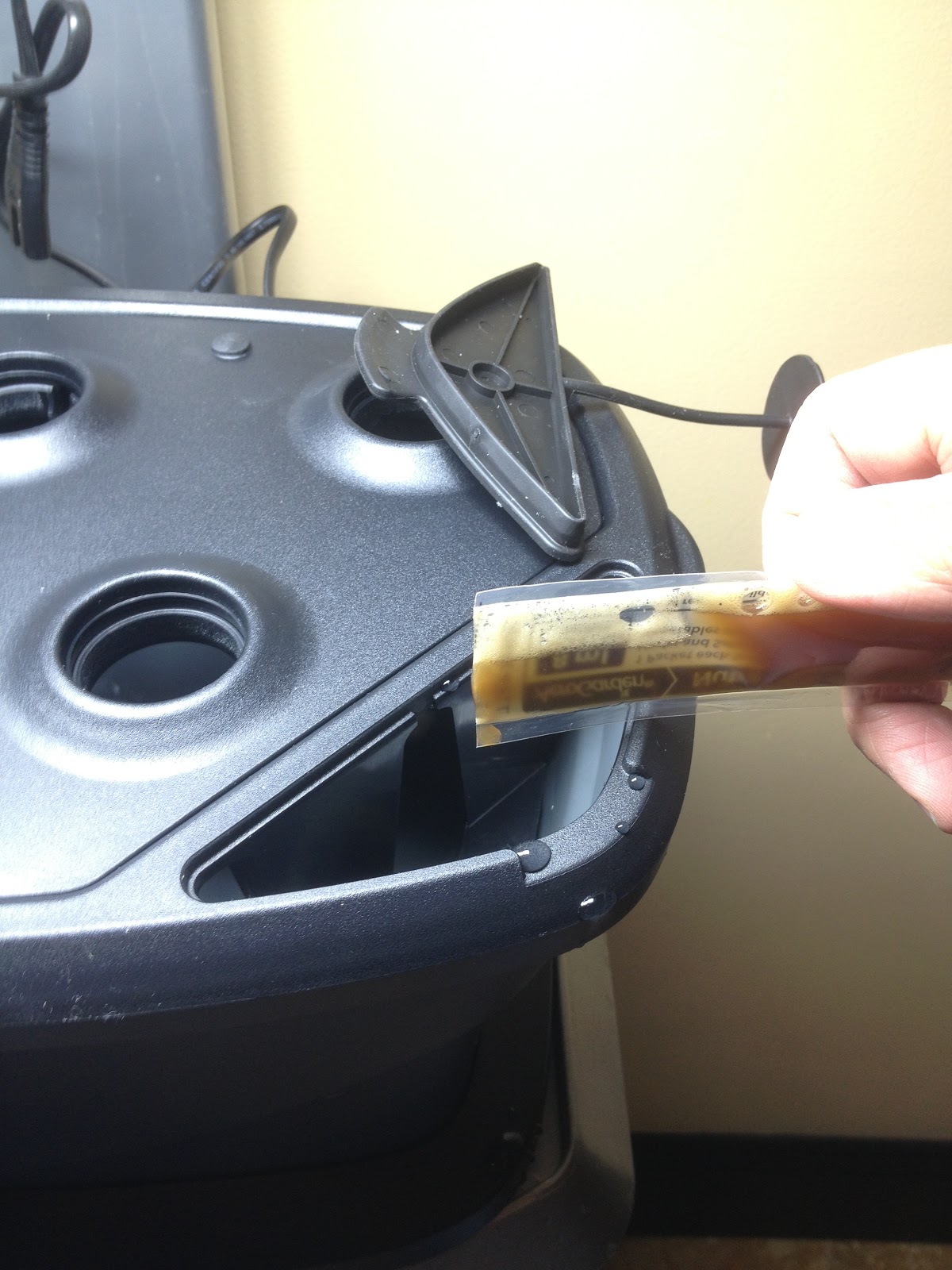

These worked great, but it rubbed me the wrong way how wasteful this solution was--the last thing our landfills need is more plastic. Worse, if you kept the packet more than a few months, they would dry out, leaving you with a pack of dried salt and brown gunk.

I should say these were salvageable. Here's what I did with dried out Aerogarden nutrient packets: just cut them into a few pieces with scissors, put them in a cup of water, and stir. The salts and nutrients will dissolve into water and be just as good as new. But yes, this was a pain.

The latest, and so far the best, solution now is that Aerogarden provides bottles of liquid plant food. Here's what the container looks like from Aerogarden's catalog (next to a fictional set of strawberry crowns).


 Like a bottle of cough syrup, it comes with a cup that you can measure and pour.

Aerogarden also sells nutrients in bulk. Here's a one quart container you can get from their store or from Amazon:


The container will last for more than 100 feedings.While they used to provide different formulations for different types of plants, nowadays they provide pretty much the same nutrients for all plants.

Whether they're in tablet, packet, or bottle form, AeroGarden's own nutrients are made up of a number of mineral salts, including potassium nitrate, calcium nitrate, mono potassium phosphate, ammonium nitrate, and magnesium sulfate. While this sounds like a chemical concoction, all the ingredients occur naturally and are balanced in just the right amounts to help plants thrive (some of these ingredients are also found in multi-vitamins). You can actually use it as nutrients for your Aerogarden, or if you dilute it with water, you can use it for your houseplants or outdoor garden as well.

At 29 cents a feeding, the nutrient is kind of pricey, though. A question I hear a lot is, are there alternatives to the Aerogarden nutrients?

The first thing to understand is--normal plant food (like Miracle Gro's traditional blue crystal plant food for houseplants) is NOT a suitable substitute for Aerogarden's liquid plant food because this kind of food is designed to work with soil--just putting it in water won't provide the pH balance or micronutrients your plants need. You do need to go with a solution designed specifically for hydroponics.

One of the leaders in the category is General Hydroponics, and a lot of people have reported success with a product called MaxiGro. This is a dry product that you mix with water. A 2.2 pound package can make about 200 gallons of nutrient solution. Assuming this equates to 266 feedings (an Amazon reader said that "two small scoops" were enough per feeding), that comes out to about 5.8 cents a feeding, which is a lot more affordable than Aerogarden.

If you prefer liquid nutrients, General Hydroponics' signature product is their Flora Series. These are a set of 32 ounce bottles that meet a variety of needs. You can read the reviews on Amazon to see others' experiences with them and Aerogardens--consensus is that you just need to mix less than their suggested dosage to see great results. With both the solid and liquid nutrients, you'll need to do a little trial and error to get to what's right for your plants.

Have you had success with alternatives to Aerogarden's nutrients? Share them here!

Monday, February 9, 2015

Happy belated 2015! Here's where we are with the strawberries!

Sorry, it's been a while since I've posted an update about my Aerogarden Strawberries. Lots going on in my life (don't worry, all good stuff), so keeping this blog up has been put a tad on the back burner. But rest assured, I'm still doing the indoor gardening, and I'm still documenting every step of the way so that you can share in my joy...and my misery :)

Honestly, you didn't miss much. I haven't bought any new air cleaning plants since my last post on the subject (sadly, the Areca Palm and the Gerbera Daisy both met their maker, but the others are doing quite well), Just when I thought my fungus gnat problem was gone at home and work, suddenly there was a whole new infestation--and this time Gnatrol didn't help (Unlike last time, the Amazon seller I bought it from this time gave it to me in a plastic baggie, and I have a sneaking suspicion that they're using an old batch. To their credit they agreed to refund my money, no questions asked--but watering the plant with an impotent tablespoon of Gnatrol just made the problem worse.

Ah, now to the strawberries. Here, you didn't miss much either. Since the last post, there was only one strawberry--one--that survived.

Now as you recall, one of my "dreams" was to grow enough indoor strawberries to make my own shortcake. Well, I have the "short" down right anyway. As in, I'm short of the number I wanted.

But it's been a learning experience. I pretty conclusively figured out that everything I said last November was on the mark, except perhaps for the temperature one. Specifically...

1) I'm not watering enough. Far and away, this is my #1 problem. I have gigantic, huge green leaves which are soaking up the light--and soaking up the water. I mean literally, I might go two days and find the reservoir almost completely dry. And what looked like a beautiful white flower a few days ago is just a dried up little stump, because the strawberry didn't have enough water to grow. So now, I literally am watering every single day.

2) I'm letting dead leaves overstay their welcome. I noticed a phenomenon where older leaves would turn brown. Turns out this is perfectly normal, and the best thing to do is the prune the leaves by cutting the stem near the root. This prevents the dying leaf from hogging up the resources, and gives a chance for new growth. Similarly, I've noticed that some of the crowns produce fewer and fewer leaves and then just stop growing. I've taken those out to make more room for the healthy ones.

3) I'm not pollinating enough. Aerogrow's instructions are to give the plants a "good shake" to pollinate them, but I've seen to many instances where the flowers give way to scrunched up, misformed fruits. I decided to make like a bee, take a Q-Tip, and go from flower to flower. That's helped a lot.

4) I'm not feeding right. Admittedly, I've let the unit go without a proper feeding for too long from time to time. Being fastidious about feeding is critical for plants staying healthy.

5) Those *%%^@#& fungus gnats. I find that they've gotten into the Aerogarden too. The good news is, the ones that have matured freak out every hour the upper basin start filling with water, and so I can vacuum them up with my Dyson handheld. I put a yellow trap that seems to catch them too. I'm not sure how many of the larvae can survive the continual cycle of watering and drying, but so far the plants seem to be winning.


Well, lo and behold, just doing these things a little more carefully has resulted in a sudden influx of flowers. In this picture you can see all the stages that happen when strawberry plants grow--you start with a white and yellow flower, then the white petals start to fall off and the middle yellow part (the stamen) starts to bulge and look like a tiny green strawberry. If all goes well, in a few days it'll get bigger and bigger, and finally start turning pink and then red.


This is a strawberry that looks like it wasn't pollinated quite right...you can see it all scrunched up and not ripening as quickly as its high-achieving sibling.


On the other hand, this is one that I deliberately and carefully hand-pollinated from the time it was just a small flower. 


Again, here you can see some of its siblings, one still in flower form, while the other a tiny berry already. 


So, the time came to harvest my second successful Aerogarden strawberry. Here's what it looked like inside, again pretty much a perfect strawberry.


The strawberry was again amazingly juicy and really, really sweet.  I mean, this didn't need any sugar or cream--it was bursting with strawberry flavor.

My only regret is that in three months, I only have two strawberries to show for it. So my dream of building a victory garden that would sustain me in my apartment if I were to be snowed in or Y2K were to hit...that'll still have to wait. But at the very least, here's hoping that all those flowers you see in the picture above will yield at least enough for me to make a strawberry shortcake cupcake :)


Sunday, December 7, 2014

The first strawberry

My first "real" strawberry, after a string of stunted and shriveled ones, came in December.

Here's what it looked like on December 4.


Notice that on the same vine, its sibling never grew more than a few millimeters in diameter before it shriveled up.

And here's what it looked like three days later on December 7.


Slicing it open, it was a perfect strawberry through and through., juicy and sweet.


Wanting to savor the moment, I actually sat down and sliced it, eating it like a steak and savoring every little bit. At this rate, I may enjoy one strawberry every few months, so I figure I'd make the most of it.

Tuesday, November 25, 2014

Peace Lily (Spathiphyllum sp.) - Best Air Purifying Plant #7

Granted, I can't say the name of this plant without sounding like Sylvester the cat, but it is one of the most popular houseplants around. Its Latin name is Spathiphyllum, where "spatha" refers to the "spathe" (which I'll describe below) and "phyllum" means "leaf".

The plant is also called a "Peace Lily", which is a bit of a misnomer because this plant isn't a lily at all. In fact, the white thing that everyone thinks is a flower is a special kind of leaf, or bract, called a "spathe".  It's more like a shield that protects the hard part in the middle of it, which is the actual flower cluster.

Here's the one I got from Garden World:


The flowers inside the spathe actually had a wonderful subtle fragrant scent. When I tapped them they also spewed out a whole bunch of white pollen powder.

It's rated 8 out of 10 for chemical removal and 8 out of 10 for transpiration, thanks to those lovely huge green leaves. Just having it around instantly brings life to a room, both in terms of the beautiful white spathes as well as the cleaner air.

When you buy one of these plants, you want to make sure you go to a breeder or garden center. Word is that when they're mass produced, they're bred so that when you buy them you see nice huge spathes in the store, but once those die, they never come back.

The Spathiphyllum comes from the tropical rainforests of South America. While the plant is known to tolerate low light conditions, this plant loves light. It also prefers a soil mixture that's looser and more porous, like orchid potting soil or a mix of potting soil, peat moss, and perlite, rather than just traditional potting soil that turns into thick mud when wet. It also loves lots of water. Keep the soil damp but not soggy and you should be fine.

I had an old Spathiphyllum for years and it was a testament to how much abuse this plant can take. My plant would go for weeks without watering, to the point where the leaves would start to droop. But after watering it, the leaves would perk up as good as new. I was proud of my plant, but one particularly dry winter I left for a three-week trip and came back to find it not just drooped, but the leaves dried out. I tried watering it, and bless its heart it tried to come back to life, but ultimately it no longer produced flowers nor spathes. Ultimately I had to throw it out, although I did save two cutting from it before I did.

1) Temperature: As with any tropical rainforest plant, keep as warm and humid as possible. Keep between 68-80 degrees Fahrenheit. Anything below 55 and they will have problems.
2) Sunlight: Light to moderate shade is best.
3) Care and feeding: Mist regularly and water frequently in summer. In winter, keep soil damp. Feed weekly in summertime with fertilizer.

Tuesday, November 18, 2014

Boston Fern (Nephrolepis exaltata "Bostoniensis") - Best Air Cleaning Plant #1

With chemical removal rated at 9 out of 10 and transpiration rate at 9 out of 10, the Boston Fern (Nephrolepis exaltata) is the top air cleaning plant on the list. Here's the one I got from Garden World, all transplanted in its nice new pot.


The Boston fern isn't from Boston and quite honestly doesn't even grow particularly well in Boston. There are varying theories of why this variation got the name. The species of Nephrolepis exaltata normally has erect fronds, but this variation of Nephrolepis exaltata cv. Bostoniensis has arching fronds. Some say that the name came when this mutation was discovered as plants were shipped from Boston to Philadelphia in 1894, while others say the name came from Florida pioneer John Soar, who shipped some of the plants to a friend in Boston. Whatever the origin, the name stuck and this plant is forever associated with Boston.

The plant is really native to humid forests and swampy areas, such as in Florida Central and South America, and Africa. Its ability to thrive in humid areas is what makes it a great air cleaning houseplant, as it is used to taking in water and transpiring it. It's that same property that makes it a bit difficult to care for, especially in rooms that we keep climate controlled and dehumidified.

There are a couple things you can do to let your plant feel a little bit more at home. Make sure to place the pot on a tray of pebbles; this way, when the water in the tray dissolves, it'll help hydrate the plant. Also, you'll want to mist the plant once or twice a week. It's not sub-Saharan Africa, but it's close enough. If you see the leaves turning yellow, it's time to increase the humidity.

You'll also want to make sure your soil NEVER dries out. This is not to say to keep it soaking, but if the soil dries out that's not going to be great for the plant.

1) Temperature: Keep between 68-80 degrees Fahrenheit. Anything below 55 and they will die
2) Sunlight: Partial shade and indirect lighting is best. Think the ground of an old growth forest.
3) Care and feeding: Keep soil evenly moist but not soggy. Does not need a lot of fertilizer, feed once or twice a month with a diluted houseplant fertilizer.

Thursday, November 13, 2014

A great garden center in Flushing and Bayside - Garden World

Now most of you who read the blog know that aside from a few links on the side, I don't do a lot of advertising. Part of it is because I do it for the love of indoor gardening, but another part is that I get so sick of bloggers who just seem to sell out with every other post being "sponsored".

That said, when I find a place I really love, I gotta talk about it. And this place is Garden World in Flushing, New York. I should start off by saying that they don't know I'm blogging about them, but I was plenty impressed with them that I figured I'd write a post on them. By the way, if you're in the NY area, there's a Groupon you can use to get a discount.

The shop itself looks pretty nondescript on the outside, just a shack sitting to the side of an H-mart. Walking in, though, you immediately see a huge area filled with supplies. They just started to put up the Christmas products as well, so there's a festive feel about it. There were also fresh apples in the back from area orchards.

The part I wanted to see was in the back--the greenhouse. This was stocked full of wonderful, healthy plants. For someone who's been buying dead and diseased plants from a K-mart under Penn Station, I was like a kid in a candy store.


They had most of the plants we've been talking about--huge golden pothos plants, dracenas, and plenty of other tropical plants. 


The proprietor of the store couldn't have been nicer to us. I read, in broken Latin, the plants I was looking for and he walked me through and showed them to me. I wanted a Bamboo Palm, but the one they had was way too big for me.


Another goal was to get a ficus robusta (rubber tree plant), but the 8" one they had was just too big for me. But I'll be back to see if I can get a 6" one next spring. 


I was happy to find a lot of the plants I'd been searching for. Clockwise from the upper left below is the Boston Fern (#1), the Peace Plant (#7), the Spider Plant (#26), and a Ficus (#15). You'll be reading more about these in the coming weeks as I transplant them. 


Something else I got? A bag of potting soil which was completely free of fungus gnats. For all the coupons I get from K-mart, one thing I learned is that buying soil or plants from a place like that, no matter how cheap you may think it is, ends up costing a lot more in the long run. 


If you're in the Flushing or Franklin Square areas, definitely check them out. 

Tuesday, November 11, 2014

Lots of dried, undeveloped strawberries--Update on the strawberries

It's been a while since I gave an update of the strawberry plants. Here's what they look like today.


Pretty impressive looking, huh? Out of all the plants I planted, only one didn't grow. Again, nice job by Aerogrow on that third batch.

I wish I could say that by now I've harvested bushels of strawberries and have been making pies, jams, and shortcakes. But alas, I've seen about 10 strawberries so far and they all look something like this.


Shriveled, brown, and looking more like a cluster of seeds than a fruit. There are a couple reasons this is happening:

1) I'm not pollinating right. Strawberries coming out malformed or small are usually due to lack of pollination. I followed AeroGrow's instructions and each time I pass by the plant I dutifully give it a good shake. But it doesn't look like that's enough to really spread the pollen. The other problem is that I sometimes don't even see the flowers until it's too late. I think the next step is going to be for me to pay closer attention to see when the flowers are budding and then use a Q-Tip or an artist's brush to hand pollinate them.

2) I'm not watering right. There have been a couple times I check the water and it's bone dry inside. Between the coco chunks and the amount of water the growing plants suck up so much water, I find that the reservoir dries up much faster than with a regular Aerogarden growth. The Grow Bowl really requires you to constantly fill up with water. But watch out--fill it a little too much and water will spill over the side, a lesson I learned a few times.

3) I'm not adding enough nutrients. Looking at the washed-out leaves, I'm wondering if the plants are lacking nutrients. I've been adding old packets of nutrients from past Aerogardens, but I think it might be time for me to go to the bottle of fresh nutrients that got shipped with the product.

4) The temperature is off. The weather and our heating system has been weird lately, meaning really cold nights and occasional periods where it's really warm. I think that might be affecting the plants as well.

So far, there's only one strawberry that looks like it might have a chance.


Its odd shape is a telltale sign of it not being pollinated well, but at least there's a little meat to it. We'll see if it continues to grow.